
How Much Does a Stage Rental Cost?
If you are planning to run an event, concert or party, you might be considering setting up a stage for your guests.
With that many guests, it may be hard for those in the back to see what is going on. With a stage, the entertainment will be at least five feet high, allowing everyone will be able to see easily.

How much does it cost to rent a stage?
The cost of renting a mobile/portable stage will depend on the geographical location, the size of the stage, if any additional equipment is needed, the rental company and the time the stage is needed. On average, plan on spending anywhere from $600 to as much as $4,000 per day for a complete stage setup. This is the price for the stage only and won’t include any additional accessories such as the sound system or skirting. Refer to our additional costs below to see other costs you may need to budget for.
We received a few quotes from stage rental companies in the United States and included them in the table below:
| Stage Size | Average Price Quoted (depends on height) |
|---|---|
| 8' wide x 8' deep | $375 |
| 12' wide x 12' deep | $650 |
| 16' wide x 8' deep | $475 |
| 20' wide x 8' deep | $550 |
| 20' wide x 12' deep | $900 |
| 20' wide x 20' deep | $800 |
| 24' wide x 8' deep | $550 |
| 24' wide x 12' deep | $750 |
| 24' wide x 16' deep | $800 |
| 24' wide x 20' deep | $1,300 |
| 24' wide x 24' deep | $900 |
| 32' wide x 16' deep | $800 |
| 32' wide x 20' deep | $1,450 |
NOTE: These prices can be higher if you were to include skirting, carpeting, raise the height and/or need additional accessories as mentioned below.
According to Roadwayevents.com, a stage rental can range anywhere from $2,100 and $4,500. A portable stage with roof and lights costs $2,100, while a mobile stage rental (with 34.5 x 27.5 roof) costs $4,500.
Stage rental overview
The estimates mentioned above should include the delivery, complete setup and tear down.
A portable stage, depending on your preferences, can include a roof with lights, loading ramp, stairs, safety railings, roof, backdrop, and skirting. This will all vary depending on the contractor, so be sure to ask about the inclusions ahead of time.
A typical setup can take one to three hours depending on the size.
Some stage rental companies may include delivery, set-up and takedown costs with the rental cost. Just ask for the terms and conditions for stage rental for more information.
What are the extra costs?
Delivery, setup, and pickup may be an additional charge if the company has to travel outside of its radius. For those who do charge delivery fees, most are going to charge $1 to $2 per mile.
Additional costs may apply if you need to hire technicians, operators, stagehands, drivers, and/or helpers to set-up and dismantle the stage after the event.
Instrument platforms, commonly offered alongside a portable stage, can cost up to $200 to $400 each, depending on the height.
A canopy to protect the stage from the outdoor elements, if not included with the setup, could cost another $400 to $650, depending on the size of it.
Lighting can cost around $5 to $175.
Mixers can cost around $20 to $250.
Microphones cost $5 to $50.
Speakers, depending on the size, can be rented for $20 to $150 each.
A complete DJ and Karaoke system setup can be rented for about $150 to $175.
Every day the stage needs to be extended, the costs can go up by more than $250 to $500 per day depending on the company policy.
Increasing the stage size can add an additional $500 to $1,000.
A scaffold used to display a banner can cost $500 to $1,500.
A generator to power lights where there is no power can cost $150 to $300 per day.
Different surfaces can add to the price. For example, grass can add an additional $0.50 per square foot while brick can add up to $1 per square foot.
Some companies may not include the skirting, the material that is hung off the side of the stage to hide all the equipment and frame underneath.
You may also need to rent stairs to get up and down the stage as well as rails around the sides in case the stage is too high.
You may need to have some type of permit to build an outdoor stage, even if it is only temporary. Check with your city to get more information.
If you would like to hire a DJ for the event so that you do not have to worry about the music, this will be an additional cost.
If you do not know much about sound equipment, you may want to think about hiring a sound technician for the event.
How can I save money?
You can save a great deal of money by taking advantage of a stage rental service that would already include setup, dismantling, and delivery or pick up costs. Try to get as much as you can in the initial quote as there can be many hidden charges when everything is said and done.
Try to book as early as possible. The earlier you book, the more you could potentially save.
In some cases, it may be cheaper to hire your own labor instead of using the stage rental service. Be sure to compare the quotes of receiving just the equipment compared to having it setup. If it’s cheaper to hire laborers, then it may be something to consider.
How Much Do Stage Curtains Cost?
A stage curtain, the large piece of cloth, specifically designed to cover a theater’s backstage area from the audience or spectators, is often used in traditional theaters or school auditoriums.
A stage curtain usually comes in dark colors, mostly black or other light absorbing material.

How much do stage curtains cost?
When receiving a quote for new stage curtains, a company will want to know what kind of curtains you’re looking to purchase, the size, accessories required and if you require a track system.
Depending on these factors and the company you’re using, the costs of a stage curtain can typically range anywhere from as little as $5,000 to as much as $65,000 to have it professionally installed. When you think of a stage curtain, it is going to be more than just the curtain — it will often include many other parts such as the track and installation.
For example, Bellatex.com says that almost 80 percent of stage curtain projects have an average cost of around $5,000 and $100,000. In addition, the costs of stage curtains, according to the project scope, can range from as little as $4,800 for a small elementary school stage to as much as $49,700 for a high school stage.
For the fabric alone, without any installation or parts involved, plan on factoring in at least $12 to $30 per yard.
For those who want a stage curtain for home use or smaller-than-average sizes, some curtains can be purchased for as little as $100 to $500. eBay, for example, has simple stage curtain backdrops, with “buy it now” prices ranging from as little as $80 to more than $300.
| Type of Venue | Project Cost Estimation |
|---|---|
| Church | $20,000 to $50,000 |
| Community Center | $20,000 to $50,000 |
| Elementary School | $5,000 to $20,000 |
| High School | $10,000 to $40,000 |
| Regional Performing Arts Center | $20,000 to $50,000 |
| Touring House | $20,000 to $50,000 |
Factors that affect the price
Type of curtain. The cost of a stage curtain is dependent on size, material options, fabric style and quality of the material.
The size. While most curtains are close to being a standard measurement, this isn’t always the case. Regardless, be prepared to pay by the yard when receiving a quote in relation to your stage size. Companies will ask for the height, width and depth of the stage to provide an accurate measurement.
Tracks required? Tracks and battens can sometimes cost as much as the curtains itself if you need them for a new project or even to replace an existing track setup. Motorized will be two to three times more than a manual setup.
Repairs to existing equipment. In most cases, a contractor will need to perform slight repairs or adjustments to the existing equipment.
Accessories such as adding letters and/or a mascot logo. Adding monogram letters, a mascot and/or fringe can add to the costs, depending on the complexity of the logo and/or the number of letters required.
Stage curtains overview
As mentioned, a stage curtain will be more than a curtain. It can be broken down as the main curtain, the valance, legs, borders, tabs, blackout drops and more. Refer to this RoseBrand.com diagram to see exactly how a stage curtain is going to look when installed.
The fabrication of curtains depends on the intended use, including the dimensions of the area to be covered, how it is going to be installed or operated, aesthetic concerns, and the budget for it. Common fabric material can include cotton or a synthetic velour.
What are the extra costs?
The professional contractor, depending on their billing policy, may also charge you for the minor items used when installing the curtains, such as the fastener, dust ruffles, paging handles, FR test swatches and other related accessories.
If you need to replace the stage curtains on an existing setup, the tracks and battens may need to be replaced, depending on the condition. If this were the case, then you could pay an additional $2,000 to $5,000. If it were a fixed motor, then the costs could be closer to $10,000.
Adding a logo and/or letters to the front of the curtain when shut can increase the costs. On average, this can increase the costs by $1,000 to $3,000, depending on the complexity and number of letters required.
Tips to know:
When measuring the height of your stage curtains, start from the topmost of the curtain all the way to the bottom. Ensure that, when measuring, the curtain is hanging straight and taut to receive an accurate measurement.
Periodically check your stage curtains for tears, stains, holes or mold. If any of these signs are noticeable, schedule a professional cleaning to prolong the life. If properly stored and cared for, you can save a considerable amount on a set of cotton velour curtains because it can last for ten to fifteen years.
How can I save money?
If the curtains are being replaced and the current tracks and battens can be used, then the costs can be much less than the estimates mentioned above. Installing new battens and tracks, if necessary on an existing project, can easily cost $2,500 to $5,000.
How Much Does a SSL Certificate Cost?
SSL, which stands for Secure Socket Layer, may sound like a complex term, but in reality, it’s not.
These certificates will validate your website’s identity and encrypt the information your visitors send to or receive from your site, keeping thieves from spying on anything that’s exchanged on your domain.
When you have this encryption, your visitors can be assured any information they share on your website is private and can’t be viewed by others.
How much does an SSL certificate cost?
The cost of an SSL certificate will greatly depend on the type of certificate you’re buying and which company you’re purchasing from. In most cases, the company issuing your certificate will only validate that you own the domain and won’t identify your identity to the user, meaning the people who visit your website will know your domain has an SSL certificate; however, it doesn’t mean the person is a scammer. This is why one SSL certificate may be more than the other. The same can be said about a brand. People online, just like a store, often don’t trust a name they haven’t heard of, and the same can be said about an SSL certificate. If your website was secured and signed by Joe’s SSL, most people may not trust this company, but they would trust a large, reputable organization such as VeriSign. When all of these factors are considered, the costs can range from $50 to $250+ per year.
Refer to our table below to see what popular SSL organizations are charging:
| Company | Price Range (per year) |
|---|---|
| Comodo | $49 to $199 |
| DigiCert | $175 to $475 |
| Entrust | $122 to $500+ |
| GeoTrust | $149 to $599+ |
| GeoTrust | $149 to $499 |
| GlobalSign | $249 to $599+ |
| GoDaddy | $69 to $299 |
| HostGator | $31 (domain validated) to $270 (extended) |
| Let's Encrypt | FREE |
| Network Solutions | $55 to $500 |
| SSL.com | $36 to $299+ |
| Symantec SSL | $399 to $999+ |
| Thawte | $149 to $299 |
NOTE: These prices were gathered in 2017 and are subject to change. Use these as an average only.
SSL certificate overview
All of your reputable companies will offer some sort of warranty, often up to more than a million dollars, customer support, a certain number of licenses, 128/256 bit encryption, a verification seal, extended validation and daily website scanning.
An SSL certificate can either be “EV,” which means it’s an extended validation, whereas a non-EV is provided for security purposes. Unlike a non-EV, an extended validation means the website will actively be pinged by the Certificate Authority on the provided IP of the domain, then a script, located on the server, compares the address of the ping to the response of the Certificate Authority and the IP you’re visiting. This ensures the website you’re visiting is the same one the CA sees. As for a non-EV, no authority will actively check the domain against a logged IP for security purposes. Lastly, a wildcard SSL will often be used by those who use a multitude of subdomains that always changing and need SSL encryptions.
What are the extra costs?
The prices quoted above are often for a single domain only. If you were to need to add additional domain names, they may be available for a slight upcharge.
How can I save money?
Let’s Encrypt is a free, automated and open certificate authority, created by the Internet Security Research Group and is also sponsored by well-known companies such as Google Chrome and Mozilla. In order to use the service, you just need to verify you own the website.
In some cases, if you were to buy for more than one year, a company may offer a discount of up to 30 percent.
A domain validated certificate will be much cheaper than an EV-certificate because, with a domain validated, the domain only has to be checked, whereas the EV certificate requires more information about the owner of the domain, which could take more of an administration effort.
How Much Does a Porterhouse Steak Cost?
A porterhouse steak is said to be the king of the steak.
After all, it is one of the more highly valued steaks because of its larger tenderloin.
Cut from the front end of the short loin, the porterhouse steak is best for grilling and broiling due to its lower content of collagen.

How much does a porterhouse steak cost?
The costs of a porterhouse steak will depend on where it’s purchased, the cut and its quality. Be prepared to spend anywhere from $10 when on sale to $22 per pound. The average price, however, will often be between $15 to $22 per pound.
The USDA, according to this Fox News article, says either the T-bone or porterhouse will cost about $10.99 per pound.
Omaha Steaks, for example, offers two 24-ounce steaks for $75, while eight 24-ounce steaks retail for $260.
According to ManTestedRecipes.com, the cost of porterhouse steak at the supermarket or butcher is usually around $10 per pound, but at fine cut could sell for as much as $25 per pound.
As for a porterhouse steak at a local restaurant, the costs for a full meal could range from as little as $25 at an Outback Steakhouse to as much as $90+ at a higher end franchise chain such as Ruth’s Chris.
Tips to know:
The porterhouse is the short loin cut of beef that includes the top loin and the tenderloin. These cuts, when purchased locally, will often be a product of the United States, fresh and 100 percent Angus beef, graded by the USDA, either as choice or prime.
When picking out a steak at the local store, be sure to look for a bright red color and thicker cut with a nice perimeter of fat.
The bone of a porterhouse steak discharges heat within the meat. This is the reason that it cooks evenly and the meat is kept from drying and deflating during the cooking process.
Compared to most meats, longer cook times are not required. The bone of the meat will conduct heat that will prevent the meat from drying out or shrinking.
To cook, FoodBeast.com recommends applying a dry rub, followed by fire grilling until an appropriate internal temperature is met. As for sauce pairing, almost anything works, from a balsamic to a whiskey/mushroom.
T-bone vs porterhouse
Sometimes, a porterhouse steak is interchangeably called a T-bone since both steaks are characterized by a “T-shaped” bone with meat on both sides.
The T-bone and porterhouse steaks are the same; it’s just that a porterhouse is a larger version of the T-bone because it’s carved from the larger portion of the tenderloin, making it the “king of the T-bone.”
The major difference between the two is the thickness as per USDA guidelines. In order to qualify as a porterhouse, the USDA specifies it must be at least 1.25 inches thick at its widest point. This isn’t true with a T-bone since it only needs to be 0.25 inches at its widest point. If it were any smaller, then it would be referred to as a club steak.
How can I save money?
Many grocery stores will often have sales throughout the week in its meat department.
With any meat, the more you purchase, the more you are going to be able to save. Large warehouse clubs such as Sam’s Club and Costco offer bulk deals. The same can be said about meat packs often found at local butchers or reputable meat markets online.
How Much Does an Ostrich Egg Cost?
The largest egg of all bird species, the ostrich egg can be cooked just like a chicken egg. Weighing an average of three pounds, one egg is equivalent to two dozen chicken eggs.

How much does an ostrich egg cost?
Depending on the size of the egg, where you’re purchasing it and the time of year, the costs of an ostrich egg can range anywhere from $20 to as much as $50+ per egg.
A fertile ostrich egg can cost double this.
Floeckscountry.com, for example, offers a variety of ostrich eggs for sale. Their jumbo fresh ostrich egg retails for $75 while the extra large fresh egg retails for $60.
Ostrichgrowers.com charges $45 for each egg.
Every so often, even though it’s rare, Whole Foods and Trader Joes often carry ostrich eggs. When they do, it has been reported the eggs cost about $20.
An empty eggshell, commonly used for art projects, can cost about $20 to $30 each.
On Amazon.com, for instance, a premium Grade A ostrich eggshell retails for about $40.
Ostrich egg overview
Eggs will range anywhere from 15 to 18 inches in diameter. Small eggs are considered those less than 15 inches in diameter while eggs larger than 18 inches are considered to be a jumbo egg.
An uncooked ostrich egg has 2,000 calories, and similar to a chicken egg, an ostrich egg has comparable amounts of fat, protein, calcium, vitamin A and folic acid per serving.
What are the extra costs?
Shipping costs, if you were to buy online, can around $5 to $20 depending on the size and weight of the package. Priority mailing options are going to cost more.
Tips to know:
Ostrich eggs can be cooked just like other eggs, assuming you have a large enough pan to cook them in. They can be soft boiled, hard boiled, scrambled or fried.
These eggs, when cracked, can be harder than a chicken egg due to the thicker shell. To crack, the most common method is via a chisel and hammer to poke a hole in order to empty the contents.
One ostrich egg is more or less equivalent to two dozen chicken eggs.
The taste of an ostrich egg is just like that of a chicken egg; however, it is a little sweeter and will be fluffier when cooked. It can be used as a substitute for both duck and chicken eggs.
It takes more time to cook an ostrich egg because its shell is thicker and harder than that of a chicken.
When refrigerated, an ostrich egg will remain fresh, either in its shell or in a sealed container, for about four to eight weeks.
The shiny shell occurs because, soon after laying the egg, the female ostrich spreads a coating onto the shell to protect it from bacteria.
How can I save money?
Some farmers may offer a bulk discount if you were to buy a dozen at a time.
How Much Does an Ostrich Cost?
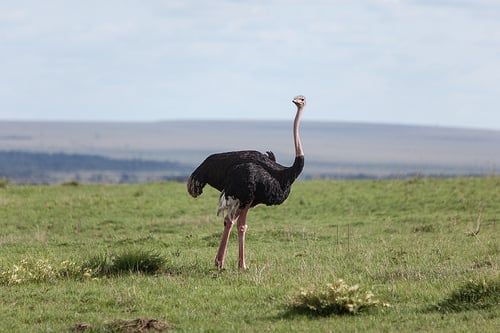
The ostrich, a large, flightless bird that originated in Africa, is often raised on its farm for its eggs, oil, boots, feathers, clothing and meat.
How much does an ostrich cost?
The cost of an ostrich may vary depending on the size, age, type, health condition, geographical location and the seller. On average, the costs of an ostrich can range anywhere from as little as $500 for chicks to as much as $50,000 for a proven breeder. Since so many health problems exist in chicks and juveniles, it can be a challenge to raise two successful birds for breeding purposes, hence the higher prices. Plus, an ostrich won’t be able to reproduce until it’s two to three years old. Refer to our chart below to see what an ostrich may cost.
For example, at Ostrichgrowers.com, chicks 30 to 60 days old cost $525, while those 61 to 90 days old cost $625. Juveniles 91 days or older can cost more than $775.
According to North Carolina University Cooperative Extension Service, a chick breeding pair of ostriches can cost $6,000 while an adult pair older than one year old can cost upwards of $12,000+
| Type of Ostrich | Average Price |
|---|---|
| Hatched Chicks | $500 to $1,500 |
| Pair of Breeding Chicks (3-6 months old) | $5,000 to $10,000 |
| Pair of yearling pairs | $15,000 to $25,000 |
| Pre-breeders older than three years old | $35,000 to $45,000 |
| Proven breeders | $50,000+ |
Ostrich overview
The average ostrich can stand about eight feet high and can weigh 200 to 400 pounds.
Three popular varieties include the Blueneck, which is the largest ostrich, the hybrid blue, and the Redeck, which is smaller than average.
Ostriches can vary in color, each representing a different subspecies. The African black, a hybrid produced from the blue and red species, is shorter, smaller and will have darker feathers than other species. The Redneck, from east Africa, has creamy white skin on the thigh, with the exception of when it’s breeder. The Blueneck, native to Africa, has blue-gray skin.
As long as healthy, an ostrich can live up to 50 years, but in the wild, the average lifespan ranges from 20 to 30 years.
What are the extra costs?
If the seller doesn’t include, a pre-purchase examination is highly recommended to ensure the bird is healthy. Most mortality rates occur before the ostrich turns six months old, and if the breeder were to offer a return policy or health guarantee, this could ease your mind knowing no diseases exist at the moment.
To protect against theft and record keeping, many ostrich owners insert a microchip, which can cost about $100 if a local vet were to install it.
Don’t forget the reoccurring costs such as the feed, vitamins and veterinarian visits. A diet is similar to what a chicken, but they also feed on seeds, roots and leaves. Plan on feeding them at least two pounds of food a day as well as four gallons of water. Most ostrich farmers report spending $50 to $75 per month on feed alone.
These birds need a fence that is at least six to eight feet tall to prevent escape or even harm. Ostriches are known to be very strong, and their kicks are known to be vicious. Each toe has a long claw, and the kick is so powerful that it could potentially be fatal. Because of this, the fences are very important and proper handling is vital.
Aside from the fencing, an ostrich needs at least one to two acres of land and should have some type of shelter from the outside elements as well.
Shipping charges may apply if you were to buy from a breeder outside your state lines.
Tips to know:
Many health problems do persist, mainly in chicks and juveniles, hence the cheaper prices. This can include starvation, malnutrition, intestinal obstruction, leg abnormalities, improper handling, stress and genetics. In the United States, a variety of diseases exists as well such as rhinitis, candidiasis, Salmonella, aspergillosis, and coccidiosis infections. Parasites identified include lice and ascarids.
While innocent, ostriches love to peck at anything shiny, such as jewelry.
These birds tend to be friendly unless they have eggs or babies around. If this is the case, they can become aggressive.
How can I save money?
You can save money by purchasing younger chicks. The older the ostrich, the more expensive it tends to cost.
How Much Does a Wrist MRI Cost?
Magnetic Resonance Imaging, more commonly known as an MRI, is a medical diagnostic test done to scan or examine a body part using a magnetic field or radio waves. The signals detected by the procedure are then sent to a computer for image processing and production. Some MRI scans are done with a dye or a contrast to facilitate imaging and enhance the accuracy of the test.

How much does a wrist MRI cost?
On average, the cost of a wrist MRI is going to vary anywhere from as little as $600 to as much as $2,200 without any sort of health insurance policy.
However, for those who do have a health insurance policy, be sure to check with your insurance company to see what is going to be covered. Most of the time, as long as it is medically necessary, the patient will only be responsible for their co-pays and deductibles. If you do not have an insurance policy or are looking to make a switch, eHealthInsurance.com allows you to browse and shop through hundreds of policies for free.
An MRI on small joints, such as the hand or wrist, costs $895, according to the Imageonemri.ca.
The Healthbluebook.com says that the cost for Wrist MRI without contrast is around $553. The price includes the combined fees for professional interpretation and technical imaging.
SaveOnMedical.com, a company that allows you to book your wrist MRI online, has providers in Tampa Bay, Florida, for example, charging $416 and more.
New Choice Medical says a fair price to pay is about $575.
Factors that affect the price
Contrast medium
An MRI scan which uses dyes or contrast will be more expensive than MRI procedure which does not need it during the process.
Location
Hospitals or laboratories from different states in the U.S. have varied rates for MRI scanning procedures. With anything in life, the geographical location plays a big role in the pricing.
Insurance
The cost of the MRI scanning procedure will also depend on the type of insurance you have. Most clinics and labs put up varied rates for HMO, PPO, or health cards if you do not have any insurance or any form of health assistance at all.
Wrist MRI overview
Before the procedure begins, the patient will have to remove any sort of metal jewelry. The patient will then have to lay on a table, which will then be entered through a tube for a test. Although it is painless, some that have claustrophobia may find it to be an issue. Once inside the machine, the radio waves will send results to a medical professional, who will then analyze them.
The procedure only lasts a few minutes and the patient can immediately go home afterward most of the time.
Wrist MRI costs usually include the professional fees for the technician who performed the procedure. The cost also includes the technical process and the interpretation of the results by a licensed radiologist.
In cases where MRI contrast is used, the price for the dye or the contrast medium will be included in the overall cost of the wrist MRI scan.
Also included in the cost is the patient’s copy of the results of the scan.
What are the extra costs?
Getting an MRI with contrast will be an additional cost with most facilities. If you were to need contrast, this could add another $100 to $350 to your price.
Since laboratories have strict schedules, you may be charged a cancellation fee if you fail to cancel within 24 hours prior to the scheduled appointment.
If the wrist needs surgery or physical therapy down the road, these are additional costs to consider.
Tips to know:
It is important that you ask your physician everything about the procedure. It is your right to know about the purpose, contraindications, side effects, risks, and advantages of the procedure or other possible options other than the MRI.
If you are to use a health insurance for your MRI procedure, make sure to clarify with it with your health insurance provider if the policy covers diagnostic procedures as wrist MRI.
Make sure you ask if there is anything you need to do in preparation for the test. A good doctor/facility should provide you with paperwork before you arrive for your appointment.
How can I save money?
Many facilities are more than happy to set up payment plans or even offer cash discounts.
A free-standing facility will always be cheaper than a hospital. If at all possible, always try to have your MRI done at a local free-standing center.
How Much Do Orchids Cost?
Ranging in different types, orchids have diverse colors and are perfect for corsages, decorations and even for an elegant display at a wedding.

How much do orchids cost?
The cost of orchids will depend on the type, where you live, the time of year and where you plan on purchasing them. On average, the prices can range from as little as $20 to more than $150 for 10 to 20 stems. Rare colors are expected to be a lot pricier than a common color.
At Amazon.com, for instance, the highly rated purple dendrobium orchids retail for less than $30 for 10 stems.
Prices for an orchid corsage can cost anywhere from $15 to $40, depending on the type, color and number of blooms.
Seedlings can cost anywhere from $7 to $20 per pack, again, depending on the type.
With so many colors to choose from, refer to our table below to see what the most popular and rare colors may cost.
| Type | Average Price (per stem) |
|---|---|
| Blue Tinted Dendrobium | $3 |
| Brown Dendrobium | $3 |
| Chocolate Cymbidium | $30 |
| Dark Lavender Cymbidium | $22 |
| Green Cymbidium | $22 |
| Green Tinted Dendrobium | $3 |
| Hot Pink Cymbidium | $22 |
| Hot Pink Dendrobium | $3 |
| Lavender Dendrobium | $3 |
| Light Pink Cymbidium | $22 |
| Light Pink Dendrobium | $3 |
| Orange Cymbidium | $22 |
| Peppermint Red Cymbidium | $22 |
| Red & Orange Cymbidium | $23 |
| White & Pink Cymbidium | $22 |
| White Catalaya | $16 |
| White Cymbidium | $22 |
| White Dendrobium | $3 |
| Yellow & Red Dendrobium | $3 |
| Yellow Cymbidium | $22 |
| Yellow Dendrobium | $3 |
NOTE: Most florists will make you purchase 30 to 50 stems at a time, and generally, the more you purchase, the lower the price can be.
Orchids overview
There are more than 30,000 species or orchids, yet there are two common varieties found when you want to make a purchase: Phalaenopsis, also known as moth orchids, and the Dendrobium, also referred to as a cane orchid. The Phalaenopsis species will have rounder flowers with a pronounced lip that grows on an angle, growing on a single stalk. These orchids are usually white, pink, purple or a mix of two colors. The Dendrobium species will have smaller flowers that will grow in rows, rising from the thicker can with several clusters.
If you purchase an orchid either online or in a store, it will more than likely be at the point of blooming and will commonly be potted in a plastic pot with moss around the roots.
Tips to know:
To care for your orchids, the warmer your room is, the short the lifespan will be once cut. If you want to prolong the orchid’s life, be sure to keep them in a cooler place and away from open windows.
As the largest family of flowering plants in the world, orchids have an estimated 30,000+ species.
An orchids needs vary by variety. Phalaenopsis, for example, is one of the easiest to take care of. It requires bright but indirect light, and its flowers last for quite some time. They are also one of the most common to find.
MNN.com talked about the seven most expensive flowers, with the Shenzhen Nongke orchid listed at number three, once selling for $202,000 at a local auction.
How can I save money?
Check out your local grocery store for a small bouquet for less than $20. Trader Joe’s, for instance, often offers small bunches for less than $20. Whole Foods Market sells orchids in a 4′ pot for as little as $10 to $20, with a variety of colors to choose from.
Buying in bulk can often bring the cost per stem down. At Sam’s Club, for example, they sell 70 stems, with prices ranging from $144 for a purple and white bicolor to $138 for a Mokara pink variety.
How Much Do Friesian Horses Cost?
The Friesian horse, considered to be the “gentle giant” of the horse world, is one of the world’s favorite breeds.
This breed stands out because of its dominant and striking characteristics, and aside from its shiny black coat and long, thick mane and tail, this horse is heavily built, extremely muscular, and is good natured.
Being one of the oldest domesticated breeds, Friesian horses have their share of contribution to the industrialization of 18th-century Europe.
Today, these horses are almost all over the world and are commonly used for driving, dressage, riding and even for light farm work.

How much do Friesian horses cost?
Depending on the age, the breeder, the quality and a few other factors mentioned below, a Friesian horse can cost anywhere from as little as $5,000 to as much as $32,000+. Do not be surprised to see show quality horses imported from the Netherlands costing upwards of $50,000. Refer to our table below to see what each classification could cost.
Depending on the degree of training, judge rating and gender, Tanbark Acres stated that most horses start at $10,000 and go up from there.
At the time of this writing, there were over 1,100 active listings on EquineNow.com, a popular online horse classified website, with prices ranging from $5,000 to more than $55,000.
| Classifications | Average Price |
|---|---|
| Common mares with 3+ years experience | $15,000 to $25,000 |
| Star mares | $25,000 to $40,000 |
| Model mares | $50,000+ |
| Preferent mares | $500,000+ |
| Stallions | $150,000+ |
| Weanling | $7,000 to $15,000 |
| Stud fees | $1,500 to $4,000 |
Factors that affect the price
Age
As mentioned, the age is a factor when pricing the horse. The older the animal is, the costlier it gets. Youngsters are known to be more affordable than the older ones since the older horse have more than likely acquired training from their breeders and owners before they are for put up for sale.
Gender
Gender is important as this does not only determine the behavior of the horse but of the risks in owning one. A mare, gelding and stallion vary in prices, but usually, stallions are the popular choice but are incredibly rare as a Friesian breed. In fact, only 800 were registered in 1990. However, the most expensive are the top-rated mares, top show horses, and the approved stallions.
Levels of training and personality
The training the horses went through help determine its current skill level. This, in turn, can affect the price. Needless to say, you will pay more for a tamed, trained, and experienced horse, not to mention that buyers will likely to pay more for horses with an excellent pedigree, personality, and looks.
Demand
As mentioned, Friesian horses are a rarity in North America, but they are still in demand. Keep in mind there could be a good chance you would need to import/ship your horse.
Judging
It must be known that Friesian horses are “judged.” This is a mandatory process wherein officials straight from the Netherlands come here in North America to evaluate the horses. The thorough evaluation involves an on-hand assessment of the horse’s quality of movement and of its conformation. The rating that the horses get will determine its rank on a “linear score” sheet given to the owner. In general, the linear scores for all the offspring of each stallion are combined and published, and this is done to evaluate the strengths and weaknesses that each stallion passes on to his offspring. Thus, the evaluation will be used as a basis for choosing the best match between sire and dam for the ultimate goal of continually improving the breed.
Studbook registry
If the horse, by chance, is registered by the stud book, then it can sell for much more than a non-stud book registered horse. The registered Friesians will depend on the age, training, quality but must abide by the standard and ratings.
Friesian horses overview
Native to the Netherlands, Friesian horses of today still resemble their ancestors. They typically have a beautiful front and thick and long mane and tail. Their feathers accentuate their dominant black color while their lofty gaits give an impression of elegance and proud stature. In addition, they have a well-proportioned conformation with a noble head placed on a slightly arched neck. In general, Friesian horses are a charismatic and dominant breed.
While the only registered color is black, they can range from a black-bay, when shedding, to a true black color.
According to the Friesian Horse Association of North America, there is a favorable height for every gender or age before they can enter the adult studbooks. Friesian stallions must be at least 1.60 M (15.3 hands) by the age of four and mares and geldings must be at least 1.54 M (15.0 hands). As for the average weight, 1,300 serves as the standard.
What are the extra costs?
Depending on the location of the breeder, you may need to have your horse shipped, and the costs will greatly depend on the distance traveled.
As with any pet, food, shelter, vet visits and accessories all need to be considered when owning a horse. Depending on how you’re housing the horse, the annual costs, for the average healthy horse, can cost close to $4,000.
Tips to know:
Some people use their Friesian horses for jumping; however, this is not encouraged as the weight and size of the horses are not intended for such activity. The two demands that tend to increase the price includes riding and diving. If the horse were registered and could perform these two tasks, then the prices you find will more than likely be on the higher end.
Of the 45,000 Friesian horses registered worldwide in the Dutch Friesch Paarden Stamboek and only 4,000 are found in North America.
Make sure the breeder buy the horse from is recognized by the Friesian Horse Association of North America (FHANA), a subsidiary of the original Dutch Friesian Horse registry (FPS).
How Much Does a Drug Test Cost?
A drug test, commonly used for pre-employment purposes, can test either your blood, hair, saliva and/or urine to detect traces of drug use.
Popular drugs tests can often detect marijuana, cocaine, opiates, amphetamine, methamphetamines, ecstasy and phencyclidine.

How much does a drug test cost?
The cost of a drug test will depend on the type of test, the number of drugs that need to be screened and where you plan on taking the test. If you were to take the test at home, for example, then the costs could be as little as $7 to $15 for a urine or saliva test. Granted, these tests should only be used for preliminary testing and won’t be accepted as an official test by an employer.
At Walgreens and CVS, for instance, at-home drug tests range from as little as $7 for an instant marijuana test to $60+ for a hair confirm multi-drug test that tests for seven common drugs.
The very popular First Check home drug test retails for less than $15 per test.
If the test were done at a local laboratory, then the costs could be anywhere from $50 to $100 for a similar urine or saliva test.
A popular laboratory, LabCorp, for example, offers private drug testing for about $125, according to those who have used their services in the past.
A hair or blood test, which tends to be the most expensive option, can cost anywhere from as little as $100 to $250 to test multiple drugs to as much as $500 if you were to need a hair test that checked for a history of alcohol abuse in the past six months.
According to the Connecticut Clearinghouse, the cost of a drug test will vary depending on the type of test and drugs being involved. Generally, they say most tests will cost $10 to $30 per test.
In the end, based on these factors, you could pay as little as $10 to more than $150+ on average, but most of the time, plan on budgeting less than $100. Be sure to refer to our table below to see what most common drug tests may cost you.
| Type of Test | Average Price Reported |
|---|---|
| 10 panel urine instant test (at home use) | $30 to $60 |
| 5 panel urine at a local/online lab | $40 to $75 |
| 10 panel urine/online at a local lab | $50 to $100 |
| Hair follicle test | $90 to $150 |
NOTE: These were just the averages collected from local labs and online. Your results will vary.
Drug test overview
Depending on the type of test, you either need to provide a sample of your urine, saliva, blood or hair, with urine often being the most common method. These samples are then tested for a presence of the drug or its metabolites, which are the substances that change as it’s processed in the liver. If the results do come back positive, then another test will be required to confirm the results.
These tests, in general, will determine if a person has used illegal drugs, either recently or over a longer period. Each test, depending on the method will use different applications to test specific drug usage.
If you have a drug test either done online or at a local lab, it can take up to three days to receive your results.
The most commonly ordered drug test will either be a five or 10-panel test. The number refers to the number of drugs the test can test for, and screening panels can test for the following:
| Drug Panel | What It Tests For |
|---|---|
| Amphetamines | Amphetamine / Amphetamine Salts / Adderall / Vyvanse, MDA / Adam, Phentermine / Adipex |
| Benzodiazepines | Alprazolam/Xanax, Clonazepam / Klonopin, Diazepam / Valium, Lorazepam / Ativan, Oxazepam / Serax, Temazepam / Restoril |
| Buprenorphine | Buprenorphine / Suboxone / Subutex |
| Cocaine | Cocaine, Benzoylecgonine, Ecgonine Methyl Ester, Cocaethylene |
| Methadone | Methadone, EDDP |
| Methamphetamines | Methamphetamine, MDMA/Ecstasy, PMMA, Ephedrine |
| Opiates | 6MAM/Heroin, Morphine, Codeine, Hydrocodone / Vicodin / Norco / Lorcet / Lortab |
| Oxycodone | Oxycodone / Percocet / Endocet / Oxycontin, Oxymorphone / Opana |
| THC | Δ-9 THC, Marijuana |
| Tramadol | Tramadol / Ultram / Ultracet |
Tips to know:
If the drug test were ordered by your employer, the 99 percent of the time, they will cover the expenses unless notified ahead of time. In these scenarios, you will need to visit the lab of their choice and often provide a urine sample on site, along with paperwork.
With urine testing being the most common option, most labs will require at least 45 milliliters.
How can I save money?
Some labs online often hold periodic specials or sales.
Some drug tests may be covered by insurance, but in order to be eligible, the test will need to be provided by a local medical facility. It doesn’t hurt to talk with your health insurance provider before taking a test to discuss your options.
Your state may have a federally funded substance abuse referral program that’s able to help refer you to a free drug facility that’s able to offer free testing. Also, some facilities across the United States also offer services on a sliding scale, helping you pay only what you can afford. To start looking for help, you can call the National Drug Abuse Hotline at 1-800-662-HELP.


